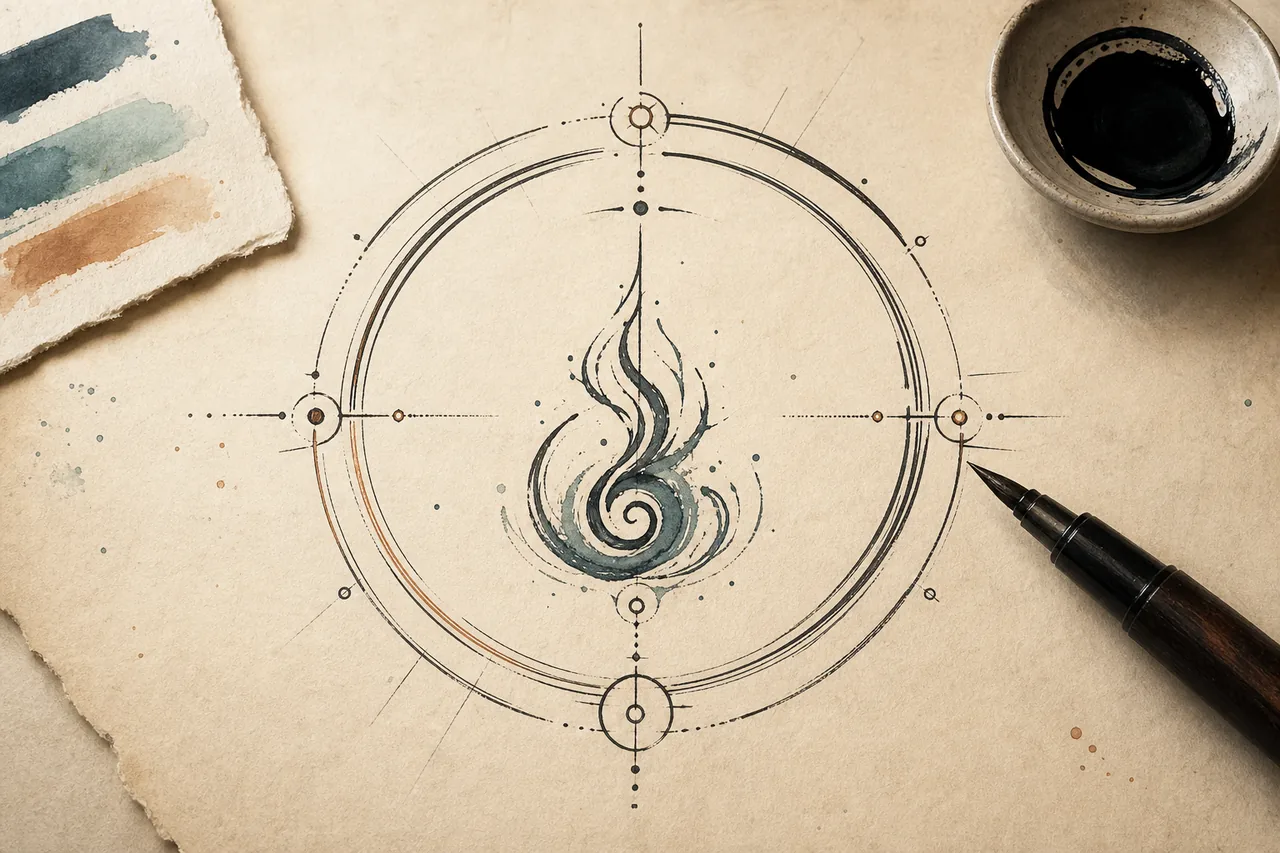
Witch Hat Atelier magic is a visual language. Instead of speaking a command or casting through innate talent alone, trained witches draw a carefully structured design with magical ink. The design tells the spell what material or force to produce, how it should move, and where its effect should stop. The final closing stroke matters because a spell is generally released only when the circle is completed.
The Witch Hat Atelier magic system is built around readable relationships between marks. Ink, a central glyph, modifier signs, and the outer magic circle work together as one drawn instruction; the simulator uses a simplified fan dictionary to demonstrate that structure.
How does Witch Hat Atelier magic work?
Magic works through knowledge, tools, and drawing technique. A person does not need to belong to a naturally different species to create magic; the decisive secret is knowing that spells can be written. Witches protect that knowledge from ordinary society, while apprentices learn how to handle ink, pens, geometry, spacing, and safe spell design.
A completed circle behaves like a compact set of instructions. Small changes can alter direction, range, intensity, duration, or the physical form of the result. That is why a beautiful circle is not automatically a useful one. Readability, proportion, and the relationship between marks are more important than decoration.
The main parts of a drawn spell
Terminology varies between translations and fan discussions, but most explanations describe three practical layers: a central sign that defines the source or substance, supporting signs that modify what happens, and a circular boundary that connects and releases the instruction.
| Part | Practical role | What can go wrong |
|---|---|---|
| Central glyph | Establishes the basic nature of the magic, such as the material or force being produced. | An unclear or mismatched symbol can make the intended effect unreadable. |
| Modifier marks | Control movement, shape, spread, direction, repetition, or other behavior. | Conflicting marks can create an unstable or unintended instruction. |
| Outer circle | Binds the parts into one design and provides the decisive closure that activates it. | A broken, premature, or accidental closure can stop or release the spell at the wrong time. |
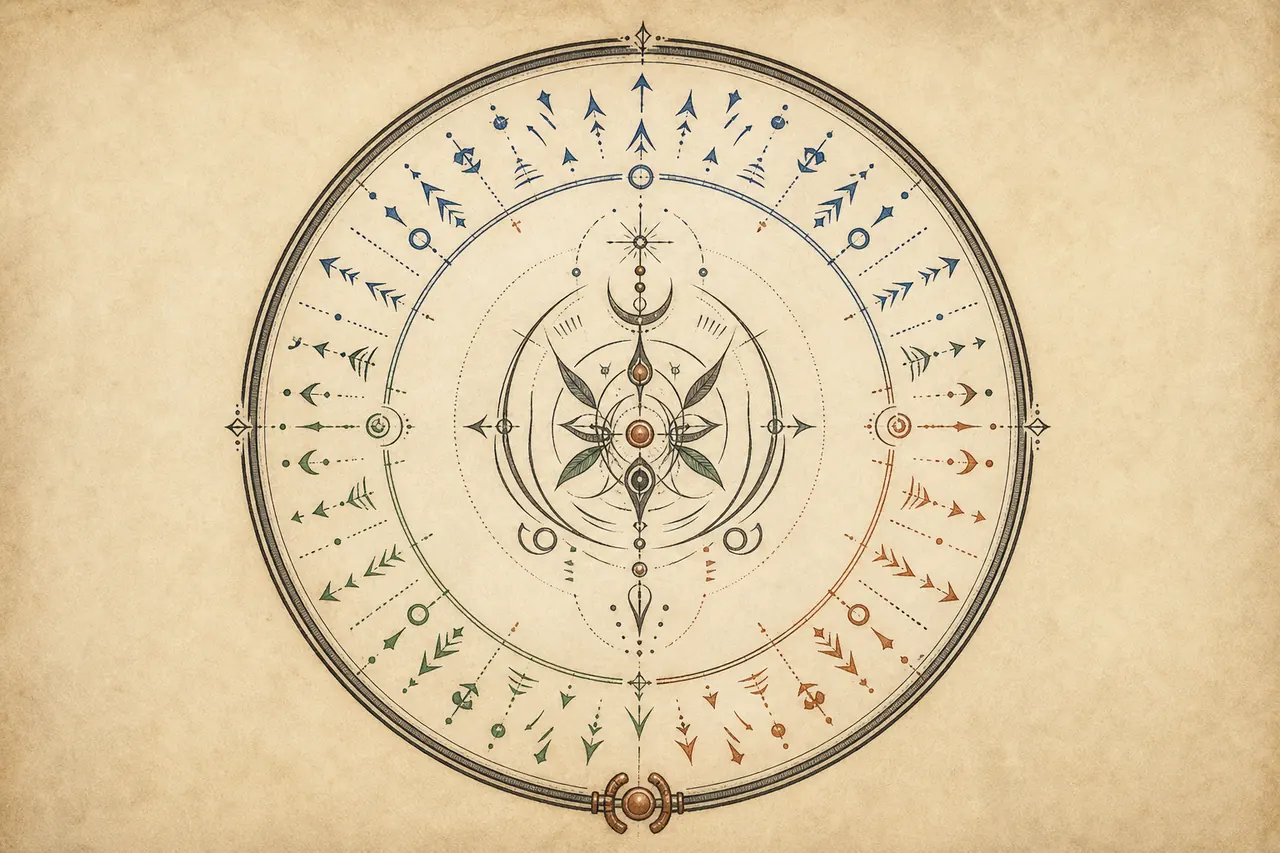
From ink to effect: how a spell activates
- Plan the result. The witch decides what the spell should create or change and chooses compatible components.
- Draw with the proper medium. Magical ink and a controlled pen stroke make the design functional rather than merely decorative.
- Arrange the instruction. Position, scale, orientation, and spacing influence how the parts are read together.
- Close the boundary. Completing the circle commits the instruction and releases the effect.
- Observe and correct. Skilled witches learn from the result, revise proportions, and avoid combinations they cannot safely control.
This craft-like process is central to the appeal of the series. Magic feels wondrous, but it also rewards drafting, repetition, and responsibility. The page is therefore more useful when read like a design guide than like a list of superpowers.
Why is the method of magic kept secret?
The secrecy is not only a dramatic rule. It shapes education, social power, and the ethical conflict of the story. If anyone could see exactly how a spell is written, magical knowledge could spread beyond trained communities. Witches therefore hide the act of drawing and maintain a public explanation that makes magic appear inaccessible to ordinary people.
That system creates protection and harm at the same time. Restricting dangerous techniques can prevent reckless use, yet controlling knowledge also decides who receives help, who becomes dependent on witches, and who is punished for crossing the boundary. The tension between safe practice and unequal access is one reason the magic system supports more than action scenes.
Spell types, transformation magic, and practical limits
Witch Hat Atelier magic can manipulate matter, movement, light, water, wind, and many other effects, but a spell still depends on a valid design and the user's ability to draw it. Large or complex results demand more planning and leave more opportunities for error. A spell can also be limited by the available surface, the ink, the speed of drawing, environmental conditions, and whether the caster understands the consequences.
Transformation and body-affecting magic deserve special caution. Searches for Witch Hat Atelier transformation magic often lead to spoiler-heavy examples, so this guide does not catalogue specific incidents. The important beginner-level point is that not every drawable effect is considered acceptable. The setting distinguishes between ordinary craft, restricted methods, and techniques whose risks are tied to the story's laws and ethics.
Canon magic versus this fan-made simulator
Our Witch Hat Atelier spell simulator borrows the satisfying idea of assembling a circle from recognizable parts, but it is not a canon recreation. The tool recognizes a small original dictionary, converts strokes into software data, and renders an interpreted animation. Its elemental sigils, quality score, stability value, and power estimate are product rules created for the browser experience.
Use the sigil reference to understand what the tool can recognize, open working spell examples for reliable presets, and follow the drawing guide when recognition fails. The technical explanation covers parsing and rendering rather than published lore.
See the visual world in the official trailer
The official anime trailer is useful here because it shows the series' emphasis on pens, circles, workshops, and carefully drawn magic without requiring us to reproduce copyrighted panels as local article images.
Frequently asked questions
Can anyone use magic in Witch Hat Atelier?
The story's central premise is that the method can be learned, but access to that knowledge is tightly controlled. Training, tools, secrecy, and safe technique still matter.
Why do witches draw circles?
The circle organizes separate marks into one instruction and its completion acts as the release point. It is both a design boundary and an activation mechanism.
How do Witch Hat Atelier magic circles work?
A magic circle organizes the central glyph and modifier signs inside an outer boundary. Completing that boundary acts as the release point in the story’s visual logic; the simulator explains the idea but uses its own simplified templates.
Are glyphs the same as spells?
No. A glyph or sign is one component. A usable spell combines components, relationships, and a completed boundary into a coherent design.
Is the magic simulator official or canon?
No. It is an unofficial fan-made interpretation with a small original recognition dictionary and software-defined effects.
Where should a beginner start?
Start with the spoiler-light concept on this page, then use our sigil reference and two prepared examples before attempting a custom circle.
Summary
Witch Hat Atelier magic works because drawing functions like instruction. Ink makes the marks active, glyphs establish meaning, supporting signs control behavior, and a closed circle releases the result. The system is memorable not just because it looks beautiful, but because knowledge, precision, secrecy, and responsibility all affect who can use it and what a spell is allowed to do.
Sources and further reading
- Official Witch Hat Atelier anime movie page — first-party trailer and visual context.
- Witch Hat Atelier Wiki: Magic — community-maintained terminology and examples; verify story details against official releases.
How Witch Hat Atelier magic circles layer
Reading a magic circle from the center outward makes the Witch Hat Atelier magic system easier to follow. The central glyph establishes the subject of the spell, while nearby signs describe how that subject should move, spread, gather, or change. The outer circle then gives those instructions one boundary. These layers are related, but they are not interchangeable: adding a second central element can create ambiguity, while moving a modifier can change the direction or balance of an otherwise recognizable design.
Layering also explains why a closing stroke is more than decoration. Before the boundary is closed, the drawing can be inspected and corrected as a prepared instruction. Once the ring is sealed, the design is treated as complete and the effect can be released. In the fan simulator, this distinction appears as a prepared state followed by an active state. The software uses its own thresholds and templates, so a clean result in the browser is an interpretation of the visual grammar, not proof of a canonical spell formula.
A practical way to study the layers
- Identify the outer boundary and leave its final gap visible.
- Check that one central sigil communicates the intended element.
- Add one modifier sign at a time and observe the direction, focus, or spread it changes.
- Review the prepared result before drawing the final closing stroke.
This center-to-edge method connects the magic system to the simulator without flattening the story into a game rule list. It also gives beginners a repeatable way to troubleshoot: repair the ring when geometry fails, repair the center when recognition fails, and adjust the surrounding signs when the effect behaves unexpectedly.